Tag: Retrofit

If you've read my previous post you'll know that, while I'm pretty happy with our choice of an air to air minisplit heat pump as our only heat source, it had some disadvantages compared to a more conventional (for the UK at least) air to water system with radiators/underfloor heating. You'll also know that I thought some of these might be solvable. Specifically the unit short-cycled a lot at low loads and was imprecise at hitting the desired indoor temperature.


Until now, the heat pump relied on a thermister built directly into the indoor unit. This meant the system was trying to measure the room air temperature right above the warm air outlet, leading to inaccuracies. These were especially bad during cold weather when the unit was working harder, and it wasn't unusual to have to push the setpoint to 23 or 24 °C in order to achieve 20 °C in the room. I suspected the thermister location was also part of the reason the unit cycled so much at low loads.


Because of these two problems I wouldn’t have felt completely comfortable, as a consultant, recommending this setup to a 'normal' person. As a geek, I can just about tolerate manually adjusting the setpoint depending on the outdoor temperature and occasionally switching the heating off completely when I notice it cycling, all in the name of research. But I suspect most people would either get very annoyed at this or simply decide the heating didn't work very well.

To try and solve this, I've recently installed a remote thermostat.


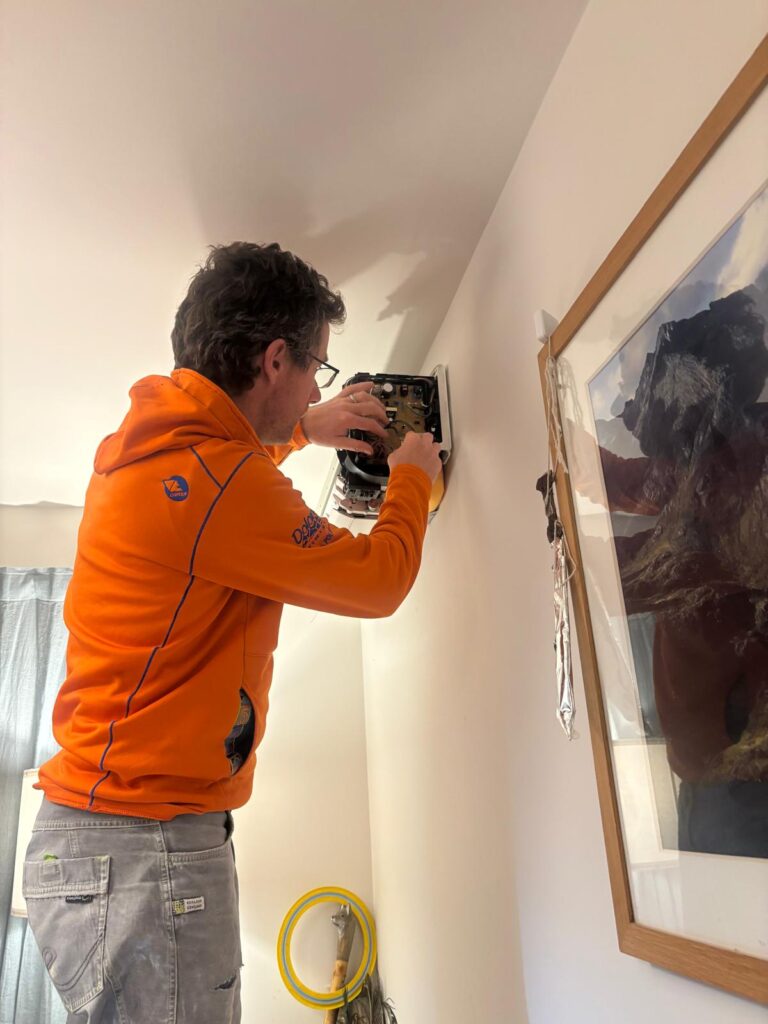
Tinkering with the indoor unit to install the remote thermostat link.
Fitting the remote thermostat link to the indoor unit involved quite a bit of watching YouTube videos of dutch air conditioning engineers. Got there in the end!

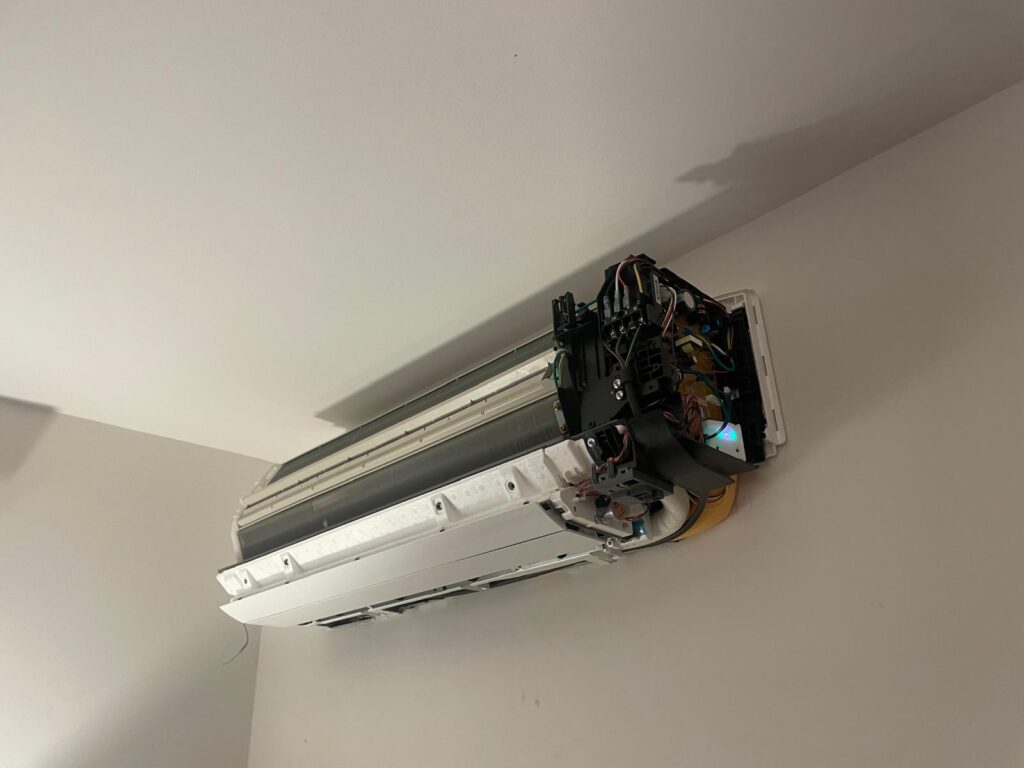
Indoor unit with the cover off.
"Daddy there's a robot in the room"

We've only had this up and running for ten days or so, but the results so far are very promising:

  • It’s far better at holding a steady setpoint.
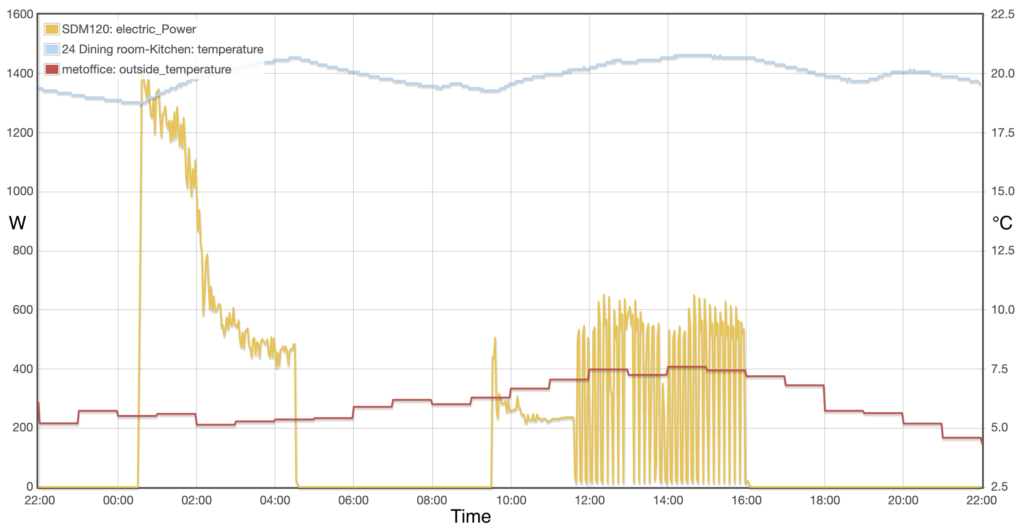
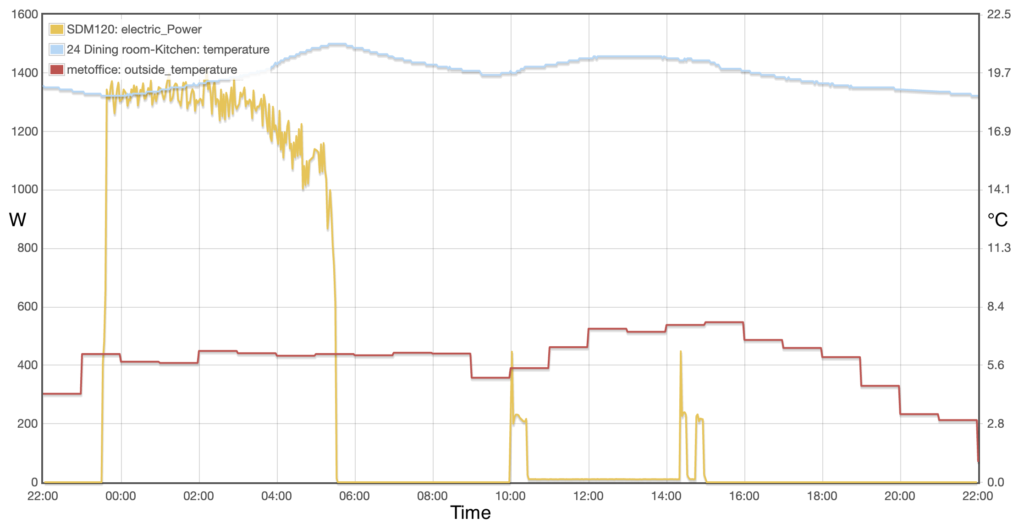
  • Cycling is much reduced. At low loads it will do longer cycles than previously, and often switch off for long periods at a time, if the room is at the setpoint temperature, when previously it would have cycled every five minutes or so.


Graph showing electrical power input, room temperature and outdoor temperature.
Without the remote thermostat this sort of behaviour was typical - during the day the room would reach the setpoint temperature then the unit would short cycle - overheating the room, annoying for anyone sat in there and much less efficient.


Graph showing input electrical power, room temperature and outdoor temperature.
With the remote thermostat fitted the unit performs much better at low loads, including long periods when it is not delivering any heat at all because the room is already at the setpoint temperature. I don't think it ever did this before.

It’s still early days, but if it keeps performing how it has in the last ten days this now feels like a configuration I could recommend to someone who just wants their heating to work without fussing over it.


Interestingly, it looks like it might be better at 'overheating' the room it's in during cheap electricity periods - the system often wasn’t achieving the target temperature before. Now it achieves this more reliably, which means we should be able to shift more of our heating electricity demand to the off-peak period of between 2330 and 0530. Over the past five days, which have been cold (around freezing), 70% of our heating electricity use has been in off peak hours. That's a lot more than the average for last year (56%), and a even better than the same 5 days in 2024 (which were also quite cold), where only 44% of heating electricity use was off peak. There's quite a lot going on there that confuses the picture - different weather, different hot water demand, longer off peak period due to a change in tariff, but as an early result it's promising. I'll have to wait till this time next year to see if it makes much of a difference over a longer period.


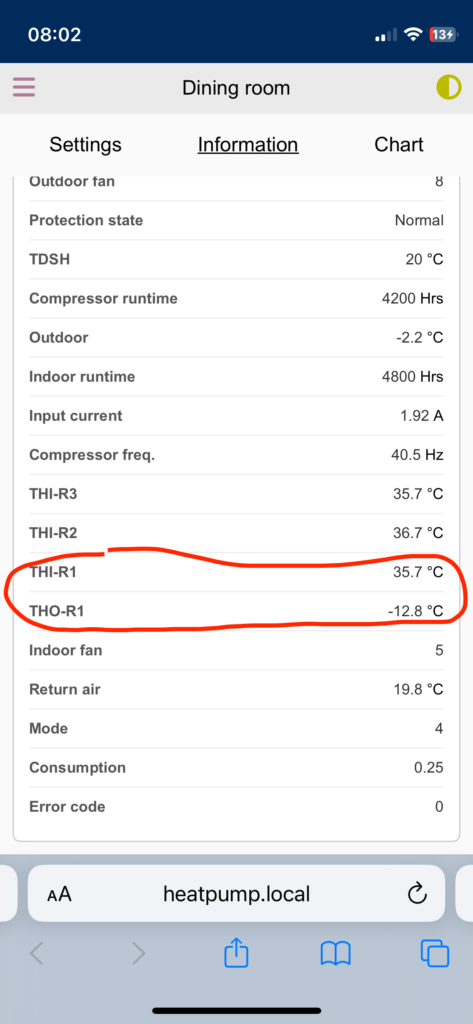
The new kit also comes with a web interface, which allows me to see some refrigerant temperatures from the unit in operation. This opens up the possibility to get a better estimate of the coefficient of performance (COP) under different conditions. I'm not sure exactly where in the heat pump cycle these temperatures are taken, but based on chatting to John Ewbank, who's doing an interesting study on air to air heat pumps, I've plugged what I think are the right numbers into the Carnot formula for the maximum theoretical COP. I'm also not sure how much to reduce these numbers by in order to get realistic real world COPs (half?)*, but, assuming I'm using the right measurement points it confirms something I'd suspected:

  • The best COPs are when the unit is operating at its lowest power input. At input powers just above 200 W the Carnot efficiency is just above 8.
  • When it's working harder the COP is not as good, with a Carnot efficiency of just between 6 and 7 for input around 500 W and a Carnot efficiency of just above 5 for an input power of 1300 W


Data from the heat pump while running.
Various interesting bits of data from the heat pump while it's running. This is with it running at between 400 and 500 W input electricity at an outdoor air temperature of -2.2 °C and an indoor temperature of 20 °C. I'm taking THI-R1 to be the 'warm' temperature and THO-R1 to be the 'cold' temperature to plug in to the Carnot formula. Under these conditions that gives a Carnot efficiency of 6.4.


These figures will change with the outdoor air temperature, but they emphasise that, all else being equal the unit should be run for long run periods. Of course, because we're on a variable tariff all else is not equal, and I suspect our tactic of overheating the dining room slightly at night is worth it - the electricity is more than 3 times cheaper then, and I don't think the reduction in COP, or the slight increase in heat loss due to warmer indoor temperatures overnight, will be anywhere near enough to offset that.


So overall very good. There are two things that I'd like to be able to do but still can't:

  • Have more programmable schedules. At the moment the unit is set to heat to 22 °C during the off-peak period and 20 °C during the on-peak. Some more flexibility would be helpful here.
  • Remote control from outside the house. I can now control the unit from my phone, but only when I'm on the same WIFI network. Being able to turn the unit on or off from outside the house would be really useful - for example to warm the house back up after a holiday, which can take several days because the power is low.
  • I'd like to get an automatic log of the refrigerant temperatures so I can look in more detail at what COPs I'm getting and look in more detail at whether it's worth running the unit 'hard' during off-peak periods.

I've a couple of ideas of how I might do those things. Watch this space.


* If anyone has any knowledge about which temperatures I should be taking from a Mitsubishi Heavy Industries unit to plug into the Carnot formula, or how much to reduce the Carnot COP by in order to get to a real-world COP estimate for an air to air minisplit, please leave a comment below.


Super efficient, simple and cheap heating, what's not to like?

Pros and cons of an air-to-air minisplit heat pump in a deep retrofit

In the UK, when we talk about heat pumps, we are normally talking about air-to-water (A2W) heat pumps (outside air is the heat source, heat is delivered to the home through water via radiators or underfloor heating), or sometimes ground-to-water (as above but with ground as the heat source). There also exist air-to-air heat pumps whereby the heat from outside air is delivered into the house via a fan-coil unit (a fan blows air from the room over the condenser coils). People often think these are bringing fresh air into the house; they aren't, only circulating indoor air over a heating coil. A separate system for ventilation is still needed.


The following are notes based on my own experience of using an air-to-air minisplit heat pump as the only heating over the past two years since moving back into our EnerPHit (Passivhaus retrofit) of a 1970s timber-frame house. I've not blogged for the last few years, so for a deep dive on what we did to our house, check out this podcast from the Energy Transition Show, this one from House Planning Help and this one from Building Sustainability. If you prefer videos check out this from Passive House Accelerator and  this from House Planning Help. There's also a podcast I recorded with Betatalk about our experience with an air to air minisplit here.


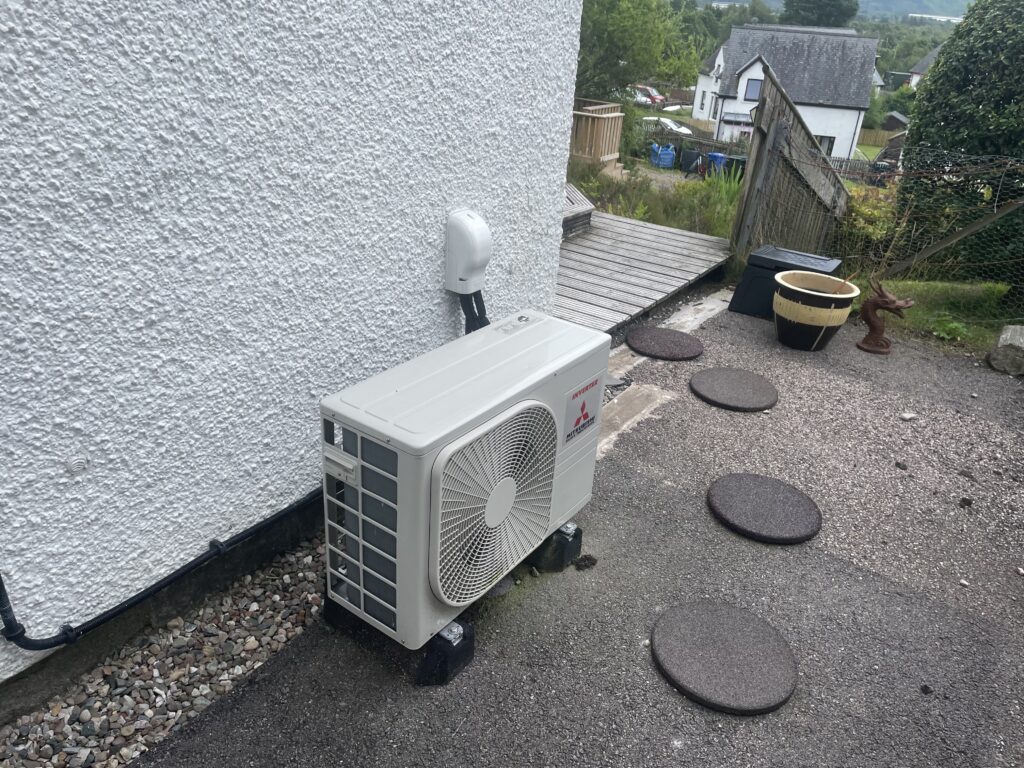
Outdoor unit of air to air minisplit heat pump
The outdoor unit of our air to air minisplit is significantly smaller than the smallest air-to-water heat pumps.


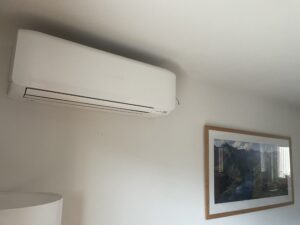
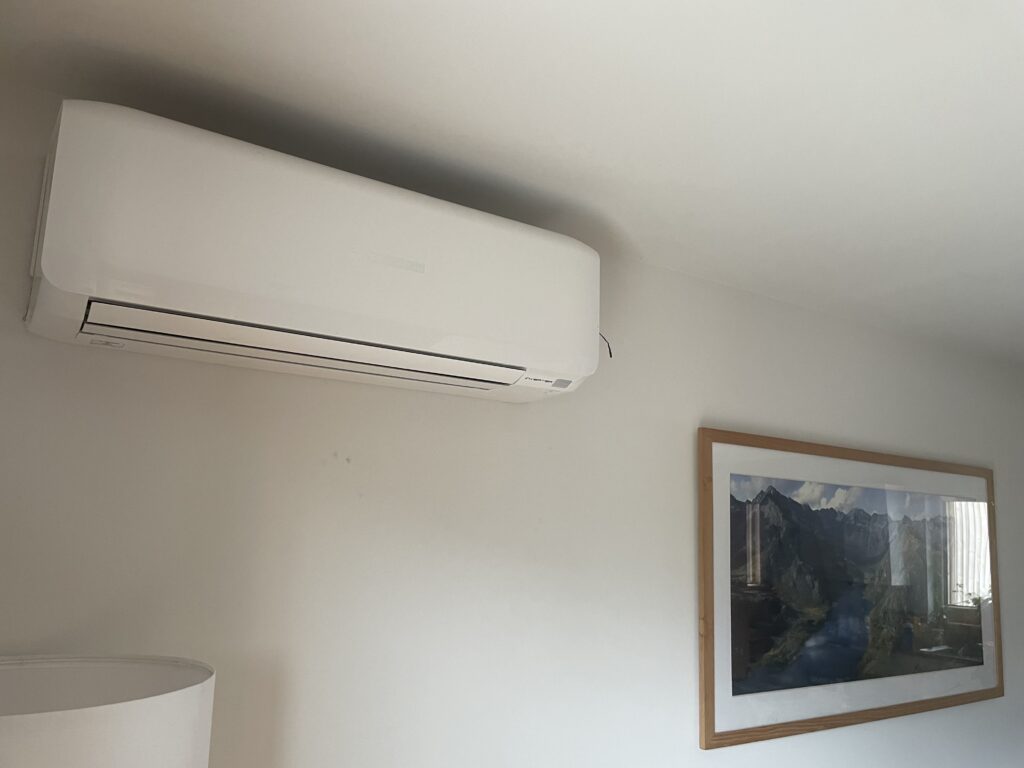
Indoor fan-coil unit of the air to air minisplit heat pump.
The indoor fan-coil unit sits in our dining room, which is centrally located on the ground floor of our two-storey, four-bedroom house. This provides all the heating for the whole house.


An air-to-air (A2A) minisplit heat pump (aka an air conditioner) can work well as a very inexpensive and efficient source of heating in homes with low heat demands. In our case we have a single minisplit, located in a downstairs dining room, and this provides all the heating for the whole house. This can be coupled with a heat pump water heater (HPWH) for hot water, either ducted to the outside or taking heat from the house. Based on my experience this system has the following advantages:


  • Very low capital cost (our A2A was £1,500 installed in 2023, plus £2,500 for the HPWH)
  • Air-to-air mini-splits are available in smaller sizes than air-to-water units, meaning the sizing is more closely aligned with typical Passivhaus heat demands
  • No space is lost to radiators
  • The outdoor units of small A2A heat pumps are considerably smaller than the smallest A2W units
  • It's straightforward to get to work efficiently in a very low demand house (I couldn’t find an A2W installer locally that would take me seriously about our post-retrofit heat load being under 2 kW and the things that needed to be done to get a 5 kW heat pump to work efficiently in such a house)
  • Minisplits can provide cooling in summer if this is needed
  • The heat pump water heater can provide ‘free’ cooling in summer if it is taking heat from the house
  • The room where the heat is being delivered can be ‘overheated’ on a cheap overnight tariff, and because bedroom doors are closed these stay cooler, the temperature evens out in the morning when bedroom doors open. This enables further savings by doing a greater proportion of the heating on very cheap tariffs


And the following disadvantages:


  • Less local control – in winter our bedrooms will typically be a degree or two cooler than the room where the heat is being delivered, although a degree or two cooler is often how people prefer bedrooms, so may not be a disadvantage. In very cold weather it's probably realistic/conservative to assume you'll want a bit of local direct electric heating for rooms that are far from the heat source, especially for sedentary activities (e.g. home office)
  • Internal doors need to be left open for a room to receive significant heat. For us this works well for the bedrooms – we don’t mind leaving the bedroom doors open during the day, and they get enough heat this way that they stay warm enough overnight. However, this will be heavily dependent on the fabric performance of the house – our bedrooms are in the new upstairs bit of our house, so are effectively new build Passivhaus standard
  • Some noticeable air movement and noise in the room where the heat is being delivered. In our house, where the heat pump is rarely working hard this is usually barely noticable (my wife comments that she genuinely never notices), but with higher heat demands it could be a problem
  • Slower hot water reheat times, although this is mitigated if HWHP is taking heat from the house (rather than ducting outside)
  • Imprecise thermostat (because it’s in the fan-coil unit) on A2A minisplit means the target temperature has to be adjusted to achieve the same room temperature, depending on how hard the heat pump is working. I’ve improved this by pulling the thermostat out so it is outside the unit. This has improved the situation somewhat, but it's still not very precise, I'm working on a solution to this
  • Some cycling at very low loads (I'm working on a solution to this along with the imprecise thermostat)
  • Ineligible for funding, and may impact eligibility for funding for other eco measures since A2A is not covered by MCS
  • The limit in terms of how much heat can be delivered to the house is not necessarily the output of the unit. For our house it is how quickly the heat can get around to the rest of the house. This is not usually a problem, but after a winter holiday where we’d had the heating off for ten days it did mean a long (2-3 days) reheat time for the house to get comfortable again
  • The controls and programming are not very sophisticated on my unit. I suspect because the manufacturers are not expecting people to use them as a main heat source. E.g. I can have a different programme for every day of the week, but I can’t tell the heating to stay off for two weeks and then come on 3 days before we get back from holiday (see above!). Other units might have more sophisticated controls. I’m aiming to solve this with the same solution that solves the cycling at very low loads and imprecise thermostat – stay tuned next winter!
  • For higher heat loads, or more spread-out houses, consider a multi-split (one outdoor unit, more than one indoor unit). The indoor units are typically the same size for units with different heating powers, so logically they must either be running at higher flow temperatures (less efficient) or higher fan speed (noisier and more air movement); adding indoor units should mitigate this

How efficient is our system, on a seasonal basis? This is not such an easy question to answer as it is with an air-to-water heat pump, because it is much harder to measure the heat output. However, I do have separate metering of the electricity use for the air-to-air heat pump and for the hot-water heat pump, and I have the modelled heat demand from PHPP. From this I can reverse engineer a SCOP. Based on this monitoring and modelling, I estimate that I'm getting somewhere between a SCOP of 4 and 5 for space heating. If it were much higher than 5 then this would imply much higher heat demand than PHPP predicts and be hard to believe in terms of heat pump thermodynamics, and if it were much lower than 4 then that would imply truly crazy low heating demand (significantly better than PHPP predicts). An SCOP of between 4 and 5 is pretty good, up there with the best performing air-to-water heat pumps on Heat Pump Monitor. In fact, in combination with the excellent fabric performance of our house it meant our house had the lowest heating costs for 2024 of any monitored on Heat Pump Monitor! We totalled £175 for heating and hot water for the first 12 months that I had monitoring, not bad for a 1970s house so far north (near Fort William).


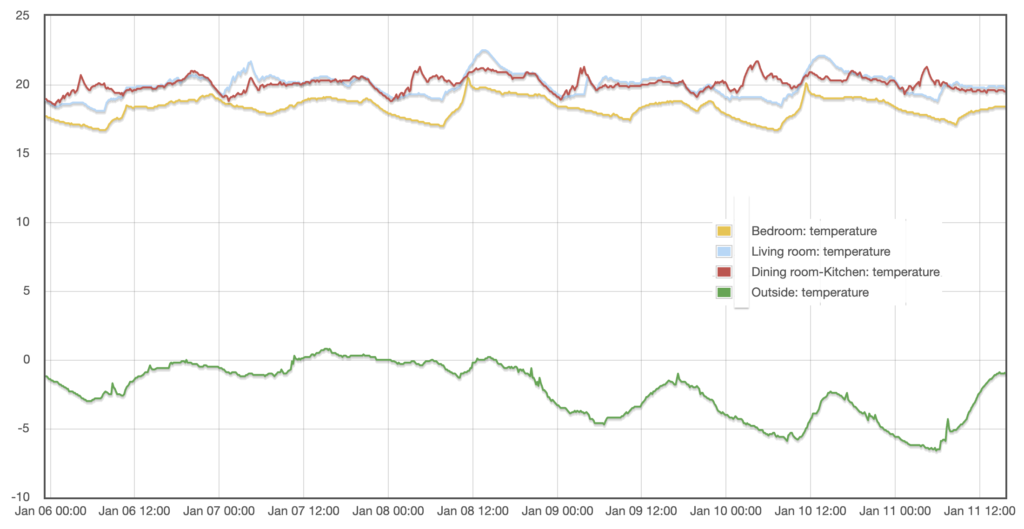
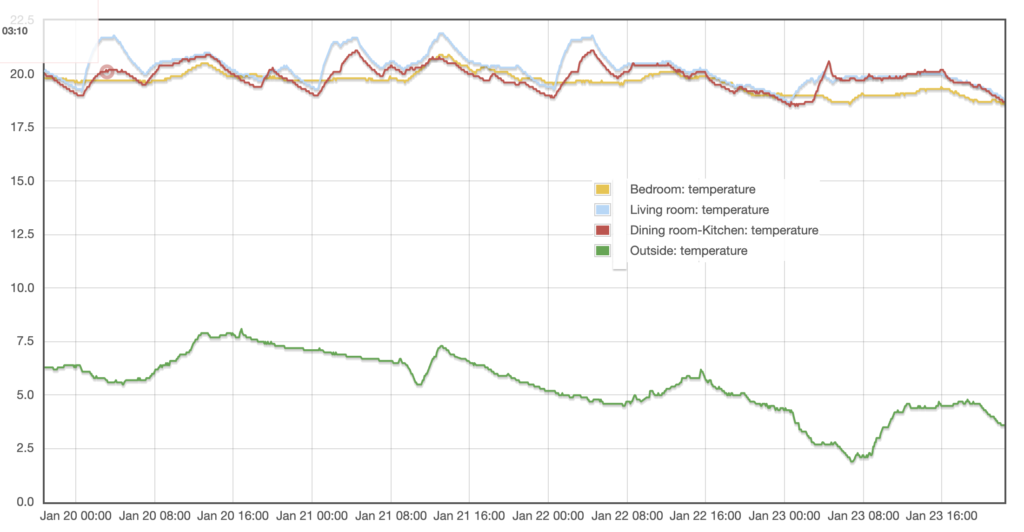
I've got temperature monitoring in three rooms of our house, the dining room (where the heat is delivered by the air-to-air heat pump), the living room (adjacent to this room) and the main bedroom, which is the furthest room from where the heat is being delivered. We've also got temperature monitoring for outside, although because this is under a porch it tends not to get the extremes of temperature, and it tends to lag the peaks and troughs slightly (in winter it gets a bit colder than the monitoring suggests, and in summer a bit hotter).


Here is the coldest week of the winter:


Graph showing temperatures in three rooms and outside during the coldest week of the 2024-25 winter.
Temperatures in three rooms and outside during the coldest week of the 2024-25 winter. The lowest indoor temperatures (17°C) are seen in the morning in the bedroom, and begin to climb rapidly immediately after this when we get up and open the door between the bedroom and the (warmer) rest of the house. Overnight spikes in temperature for the dining room and living room can be seen - this is us using a very cheap overnight tariff to 'pre-heat' the house, which we can do without making the bedrooms too warm.


And here is a more typical winter week:


Graph showing temperatures in three rooms and outside during the a typical winter week.
During a typical winter week you can see the same trend of the bedroom being colder than other rooms overnight (down to 18°C), but it recovers more easily during the day and is generally closer in temperature to the rest of the house.


In summary, an air-to-air minisplit can work very well, and be very cheap. This is attractive for Passivhaus buildings where saving thousands of pounds on the heating system can help pay for some of the other things you wouldn't be paying for on a conventional build. However, I would be very wary of using such a system in a conventional leaky house. It works well in our house precisely because it never has to work very hard or move very much heat between rooms. In most houses I would expect an air-to-water heat pump to be more suitable.


I'll write a separate post soon on the pros and cons of hot water heat pumps and whether to have them taking heat from inside or outside the house.


Some other folk have had some useful things to say about air-to-air heat pumps. See this from John Ewbank, and this and this from John Cantor.


In the previous post I looked at the main factors other than internal air temperature that affect how thermally comfortable we feel in a room. Internal surface temperature played a big role, both because of its influence on radiant heat loss and because of the ability of cold surfaces to cause fast-moving air through down draughts.

(more…)


I live in a 70’s house that has had double glazing installed but little else in the way of thermal improvements since then. Imagine the following situation. Yesterday was a mild winter’s day, temperatures around 10°C, and I was comfortably warm working at home. Today the weather’s changed, it’s been cold all night and now it’s hovering around zero and cloudy outside. Wearing the same clothes, and with the thermostat set at the same temperature, I feel chilly. After spending the morning cradling numerous cups of tea and still not warming up I finally turn the thermostat up a degree. Why, if the air temperature inside my house is the same on both days, do I feel colder today?

(more…)